

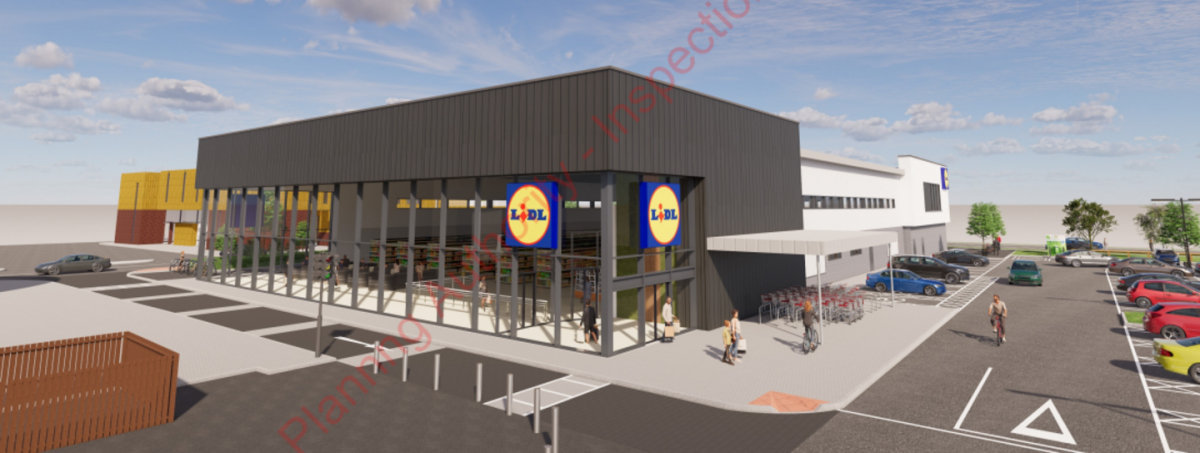
Lidl Ireland has been granted permission by Clare County Council to demolish and rebuild its Shannon store at double its current size, a scheme that matters to building and architecture professionals because it shows a major retailer continuing to commit capital to physical store redevelopment even as safety and community objections lengthen the planning timeline.
Lidl Ireland is the Irish arm of German discount retailer Lidl, part of the Schwarz Group, operating more than 190 stores across the Republic of Ireland from three regional distribution centres.
The new Shannon store will span 2,560 square metres, twice the size of the existing premises, and will include an off-licence, roof-mounted solar panels and 145 parking spaces, including 5 disabled bays and 2 electric vehicle charging points.
The Health and Safety Authority, the HSE and Shannon Airport Group all called for specific safety measures in the final plans, while 8 residents of Dernish Lawn objected over noise and visual impact concerns.
The structural driver is Lidl Ireland's €600 million, five-year investment programme covering 35 new stores and a €200 million regional distribution centre at Little Island, Cork, of which store redevelopments like Shannon form a recurring, lower-profile component alongside the flagship distribution project.
For the sector, the timing matters because Lidl continues to prioritise larger-format, sustainability-led concept stores, with solar panels and EV charging now standard features, even as individual schemes face lengthened timelines from statutory safety consultees and resident objections.
The involvement of the Health and Safety Authority, HSE and Shannon Airport Group on a single retail redevelopment illustrates how proximity to sensitive infrastructure such as an airport can multiply the number of statutory bodies a contractor and design team must satisfy before a straightforward store rebuild can proceed.
The broader implication for the sector is that retailers pursuing rapid store network expansion are increasingly absorbing multi-body safety consultation as a standard cost of doing business, giving specialist retail design and construction teams a growing, if unglamorous, pipeline of similar demolition-and-rebuild projects.
Source: Clare FM







.png)

