

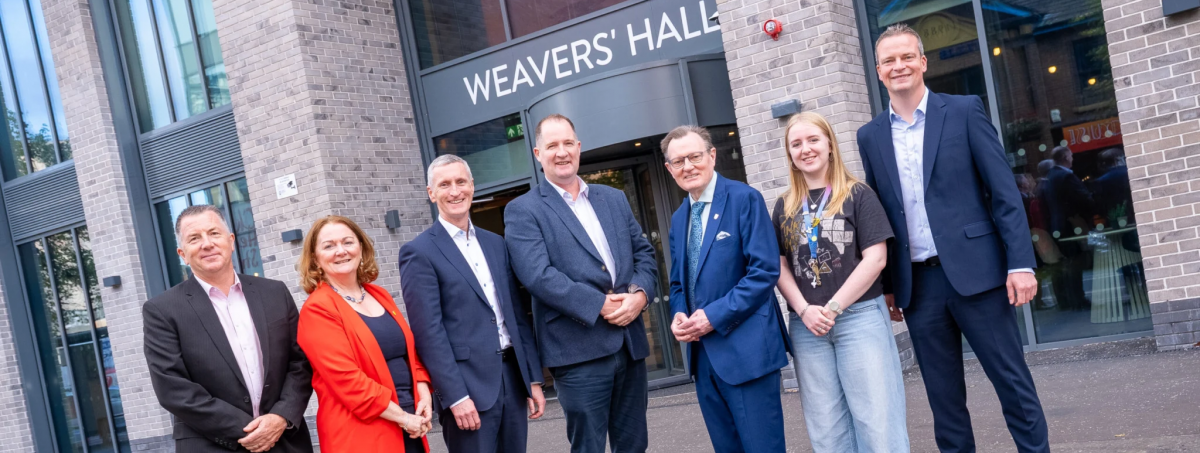
GRAHAM has handed over Weavers' Hall, a 16-storey, 459-bedroom Passivhaus student accommodation tower on Dublin Road in Belfast, Northern Ireland, for Queen's University Belfast, a delivery that matters to building and architecture professionals because it shows the Passivhaus standard being achieved in a high-rise, multi-occupancy building above the 35-metre tall-building threshold.
GRAHAM is a UK and Ireland construction group headquartered in Hillsborough, Co Down, appointed by the university under the Major Works Framework managed by Pagabo before design development began.
Queen's University Belfast is the client and end operator of the building, which is the first Passivhaus student accommodation in Belfast and combines cluster apartments with studio units, study spaces and communal lounges.
Ciaran Leahy, contracts director at GRAHAM, said: "Because we were in from day one, we could design out risk at the fabric level, from the external airtight membrane to the ventilation strategy, rather than trying to retrofit performance and the Passivhaus principles thereafter."
RPP Architects acted as architect, Etive Consulting and Bennett Freehill formed part of the consultant team, and Mosart certified the Passivhaus standard.
The structural driver is university estates strategy shifting to low-carbon purpose-built student accommodation, with this concrete-framed scheme of 459 bedrooms and 12,159.8 sq m aiming for Passivhaus Classic certification from the outset, rather than adding energy targets after design.
For the sector, the timing matters because the delivered airtightness of 0.49 air changes per hour beat the 0.6 Passivhaus requirement by almost a fifth, while a switch to CEM II cement cut embodied carbon by 166 tonnes of CO2 equivalent, giving specifiers measured high-rise performance data.
Early contractor involvement under a framework route let cost planning, design and planning run in parallel, and the Brick Development Association has already scheduled a session on the scheme's facade approach, showing how quickly project knowledge is entering wider practice.
The broader implication for the sector is that high-rise Passivhaus delivery is moving from pilot to repeatable method, particularly where contractors, architects and Passivhaus consultants are appointed together before design development begins.
Source: GRAHAM / Passivhaus Trust / Brick Development Association






.png)

