

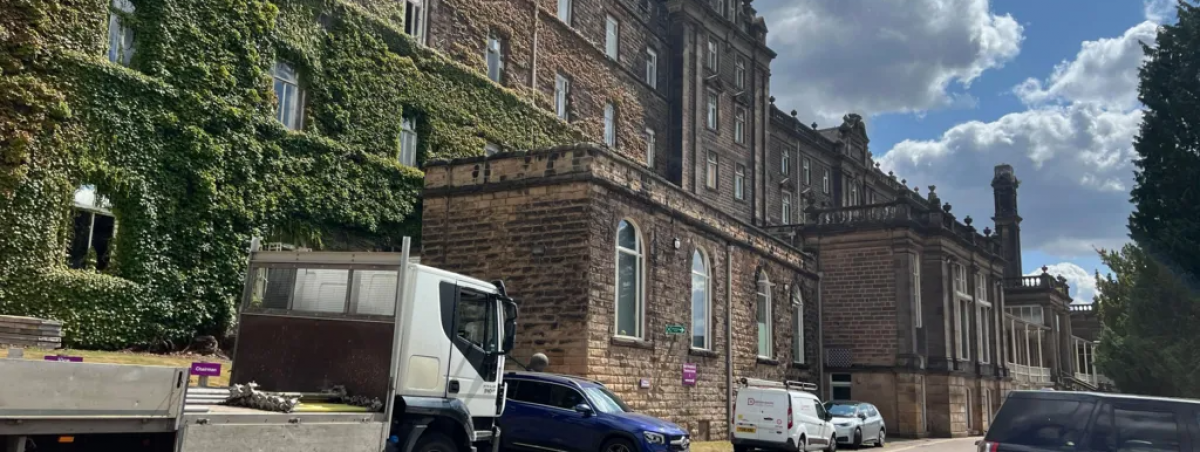
Derbyshire Dales District Council's planning committee is recommended to approve Derbyshire County Council's £130 million plan to convert its Grade II-listed Matlock headquarters, Smedley's Hydro, into a hotel and new homes, a scheme that matters to building and architecture professionals because it tests whether heritage-led adaptive reuse can be a viable exit route for councils quitting outdated civic buildings. Consideration was disclosed at £130 million, though the council had budgeted £20 million over three years, with private developers funding the remainder.
Derbyshire County Council is the local authority for Derbyshire, currently occupying County Hall, and is due to be abolished under local government reorganisation in March 2028.
HLM Architects has acted as the project's masterplanning architect since 2022, developing a mixed-use framework spanning civic, residential, hospitality and cultural uses across the 83,000 sq ft complex.
The scheme would convert the listed South Block into a hotel of more than 100 bedrooms, restore the Winter Gardens as an events venue, and add 45 flats and 50 new houses.
Montagu Evans is managing procurement and planning for the council, working with Real Estate Works, Browne Jacobson and 31ten as part of the HLM-led project team.
The structural driver is a wider pattern of UK councils exiting costly civic headquarters for adaptive reuse, following Liverpool City Council's 2017 sale of its Municipal Buildings, converted by Fragrance Group into a hotel that opened in 2023 after a £40 million redevelopment.
For the sector, the timing matters because the latest planning officer report flags severe doubts over the scheme's financial viability, even as it recommends approval, showing heritage conversions can win planning support while still carrying real delivery risk for whichever developer is appointed.
The council's own abolition under 2028 local government reorganisation adds pressure to secure a development partner and lock in the masterplan now, since an incoming unitary authority may not share the current administration's commitment to the scheme as designed.
The broader implication for the sector is that Grade II-listed civic buildings are an increasingly active hotel conversion category, giving heritage architects and specialist contractors a growing pipeline of adaptive reuse projects distinct from conventional new-build hotel work.
Source: BBC News / Derbyshire Times / Place Midlands






.png)

